
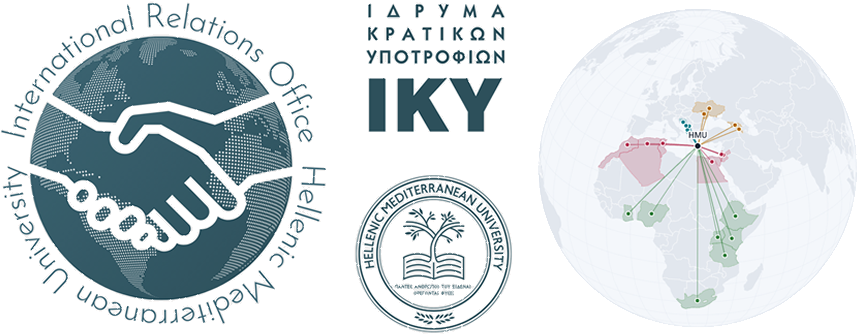
The Hellenic Mediterranean University has been awarded a new Erasmus+ KA171 project for the 2026 call (agreement 2026-1-EL01-KA171-HED-000442730), funding 66 mobility places with 68 partner universities across 22 countries and four world regions, with a total grant of €247,577.
KA171 (International Credit Mobility; ICM) lets our students and staff spend a period of study, teaching or training at a partner university outside the EU programme countries, and brings their students and staff to Crete. For 2026 the grant covers 24 places in the Western Balkans, 17 in the South-Mediterranean countries, 13 in Sub-Saharan Africa and 12 in the Neighbourhood East distributed in 42 staff and 24 student mobilities, of which 37 come to Crete and 29 travel out.
A first: South Africa joins the network
The 2026 project opens our first KA171 partnership with South Africa, through the Durban University of Technology, a new country on the HMU map, joining the twelve partner universities already working with us across Sub-Saharan Africa.
Twelve new universities we look forward to welcoming
Alongside the partners we already know well, twelve institutions join the network for the first time, spread over nine countries:
Western Balkans
- KPT shpk, Albania
- European University of Tirana (Universiteti Europian i Tiranës), Albania
- Sarajevo School of Science and Technology, Bosnia and Herzegovina
Neighbourhood East
- Armenian State University of Economics, Armenia
- Shirak State University named after Nalbandyan, Armenia
- Georgian American University, Georgia
- Alecu Russo Bălți State University, Moldova
- Technical University of Moldova (Universitatea Tehnică a Moldovei), Moldova
South-Mediterranean
- Heliopolis University, Egypt
- Max Stern Yezreel Valley College, Israel
- Université Mohammed V de Rabat, Morocco
Sub-Saharan Africa
- Durban University of Technology, South Africa
A deeper commitment to the Western Balkans
Our closest neighbours get the most room to move. Albania, Bosnia and Herzegovina, Kosovo and Montenegro each receive six places in 2026, up from three or four in the 2025 project, across 16 partner universities in the region. It is the largest regional allocation of the project and reflects how active these partnerships have become.
What happens next
The International Relations Office will publish the calls for staff and student mobilities for each destination during the academic year. Selected participants receive an individual support grant and a travel grant. Explore the globe above to see every partner country and the universities behind each route. If your department already collaborates with one of them, or would like to, get in touch with the International Relations Office.