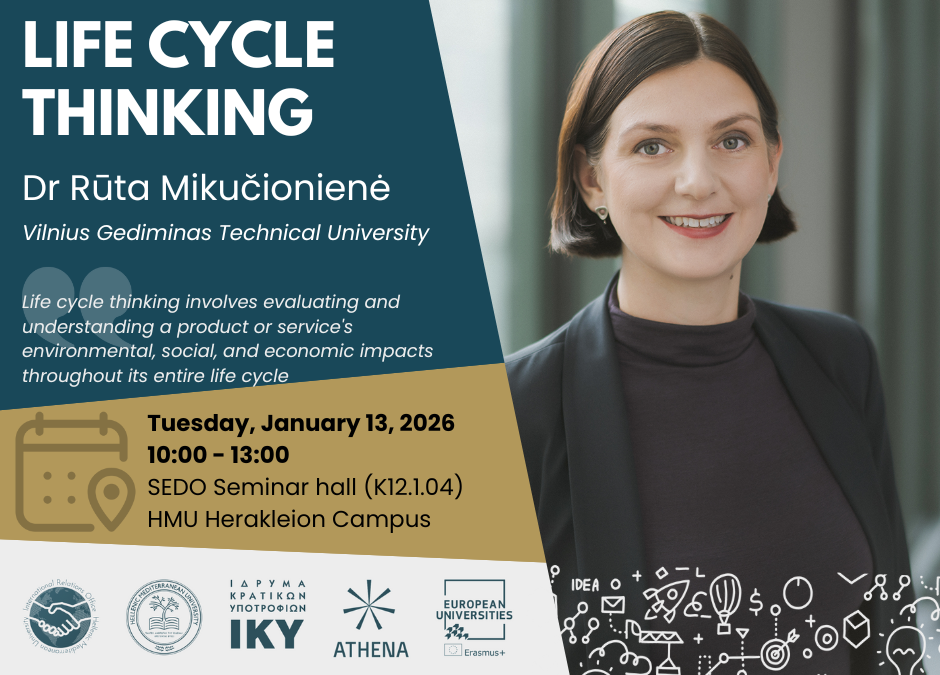
We are pleased to invite you to the upcoming Seminar: Life Cycle Thinking on Tuesday, January 13th at 10:00-13:00 at the SEDO Seminar hall (K12.1.04) at the HMU Heraklion Campus, featuring Dr Rūta Mikučionienė, Associate professor at the Department of Building Energetics, Faculty of Environmental Engineering at VILNIUS TECH and vice director of Sustainability HUB at VILNIUS TECH.
REGISTRATION LINK: https://forms.gle/8xvfJ6nKwiFx2TQk8
Short description of seminar:
Life cycle thinking involves evaluating and understanding a product or service's environmental, social, and economic impacts throughout its entire life cycle — from conception to end-of-life disposal or recycling. The seminar will consist of a theoretical part, including a presentation of the main principles of life cycle thinking, and a practical part, consisting of a workshop in which student groups will evaluate the environmental impact of chosen products and present their findings to the audience.
In addition to life cycle thinking principles, the seminar will introduce how BIM, BEM, and digital twin technologies can support sustainability decisions in building projects. Participants will see how these digital tools help assess energy performance, verify model quality, and improve planning and
operation throughout the building life cycle.
Annotation
Life cycle thinking is a comprehensive approach to evaluating the environmental, social, and economic impacts of a product or process throughout its entire life span, from idea, raw material extraction, to disposal or recycling. It offers a holistic perspective, emphasising interconnectedness
and the importance of considering all stages to prevent unintended negative consequences. Understanding the full spectrum of impacts fosters informed decision-making and proactive sustainability measures, urging a shift from isolated solutions to integrated, long-term strategies. This thinking aims to ensure balanced and sustainable choices by highlighting the intricate web of implications in our choices. By combining life cycle thinking with BIM-based energy analysis and digital twin monitoring, environmental impacts can be evaluated more accurately and continuously. Information Delivery
Specifications (IDS) ensure reliable data exchange and model consistency, while digital twin examples show how real-time building data can improve efficiency and sustainability over time.
About teachers:
Dr Rūta Mikučionienė has a PhD in Energetics and Power Engineering. She is an associate professor at the Department of Building Energetics, Faculty of Environmental Engineering at VILNIUS TECH and vice director of Sustainability HUB at VILNIUS TECH. Her main areas of scientific activity are energy efficiency, sustainability in buildings, and life cycle analysis. She has more than ten years of teaching experience and teaches the following subjects to master's students: Life cycle analysis, Energy demand management, and Feasibility studies.
Dr Rasa Džiugaitė-Tumėnienė is currently an associate professor at the Department of Building Energetics, Vilnius Gediminas Technical University (VILNIUS TECH). Her main research activities focus on developing the interface between Digital Twin technologies and Building Management Systems (BMS) to improve existing buildings' energy efficiency and sustainability. She also works on optimising the transformation of Project Information Models (PIM) into Asset Information Models (AIM) using tools such as Dalux FM, Granlund Manager, and the COBie standard.